Back Workout At Home Without Equipment: A Simple Plan
By:Author:Ketoway Editorial
Updated on:October 18, 2026

- A Week of No-Equipment Back Training You Can Copy
- How Often to Train Your Back Without Weights
- Bodyweight Rows Versus a Gym Back Day
- Making a No-Equipment Back Routine Fit Your Day
- Adapting Bodyweight Back Training to Your Situation
- When Back Training Motivation Usually Fades
- Pairing a Home Back Workout With Ketoway
- Getting Your First Session Done Tonight
Yes, you can build a stronger back at home with no equipment - rows, supermans, and pulling-pattern holds all load the muscles along your spine and shoulder blades without a single weight.
Your back muscles respond to tension and time under load, not to the tool creating that tension. A towel, a doorframe, or just your own bodyweight held at an angle can create enough resistance to make those muscles work.
This article covers a sample week, how often to train, why the simpler route tends to stick, and how to fit it around a real schedule.
A Week of No-Equipment Back Training You Can Copy
Here's a realistic weekly layout built entirely from bodyweight moves - no bands, no bars, no dumbbells.
A Sample Week
- Monday - Supermans, reverse snow angels, prone Y-raises
- Tuesday - Rest or a short walk
- Wednesday - Towel rows under a table, doorframe rows, bird dogs
- Thursday - Rest or light stretching
- Friday - Supermans, prone T-raises, plank-to-downward-dog holds
- Saturday - Doorframe rows, reverse snow angels, bird dogs
- Sunday - Rest
Each session only needs ten to fifteen minutes once you know the moves, which makes it easy to slot in before work or after dinner.
How Often to Train Your Back Without Weights
Finding a Frequency That Fits
Bodyweight back work doesn't need to happen daily to add up over time, since the muscles need recovery between sessions just like any other training.

| Goal | Frequency | Session Length |
|---|---|---|
| Just starting out | 2 sessions a week | 10 minutes |
| Building a habit | 3 sessions a week | 12 minutes |
| More consistent training | 4 sessions a week | 15 minutes |
| Combined with other training | 2-3 sessions a week | 10 minutes |
Two sessions a week is enough to start noticing the moves feel less awkward, and that's usually the point where people add a third.
Bodyweight Rows Versus a Gym Back Day
A gym back day with a lat pulldown machine and cable rows can load the muscles heavily, but it only works if you actually get to the gym.
A bodyweight session using a sturdy table edge or a doorframe for rows asks less of your schedule - no commute, no waiting for equipment, no membership to keep paying for.
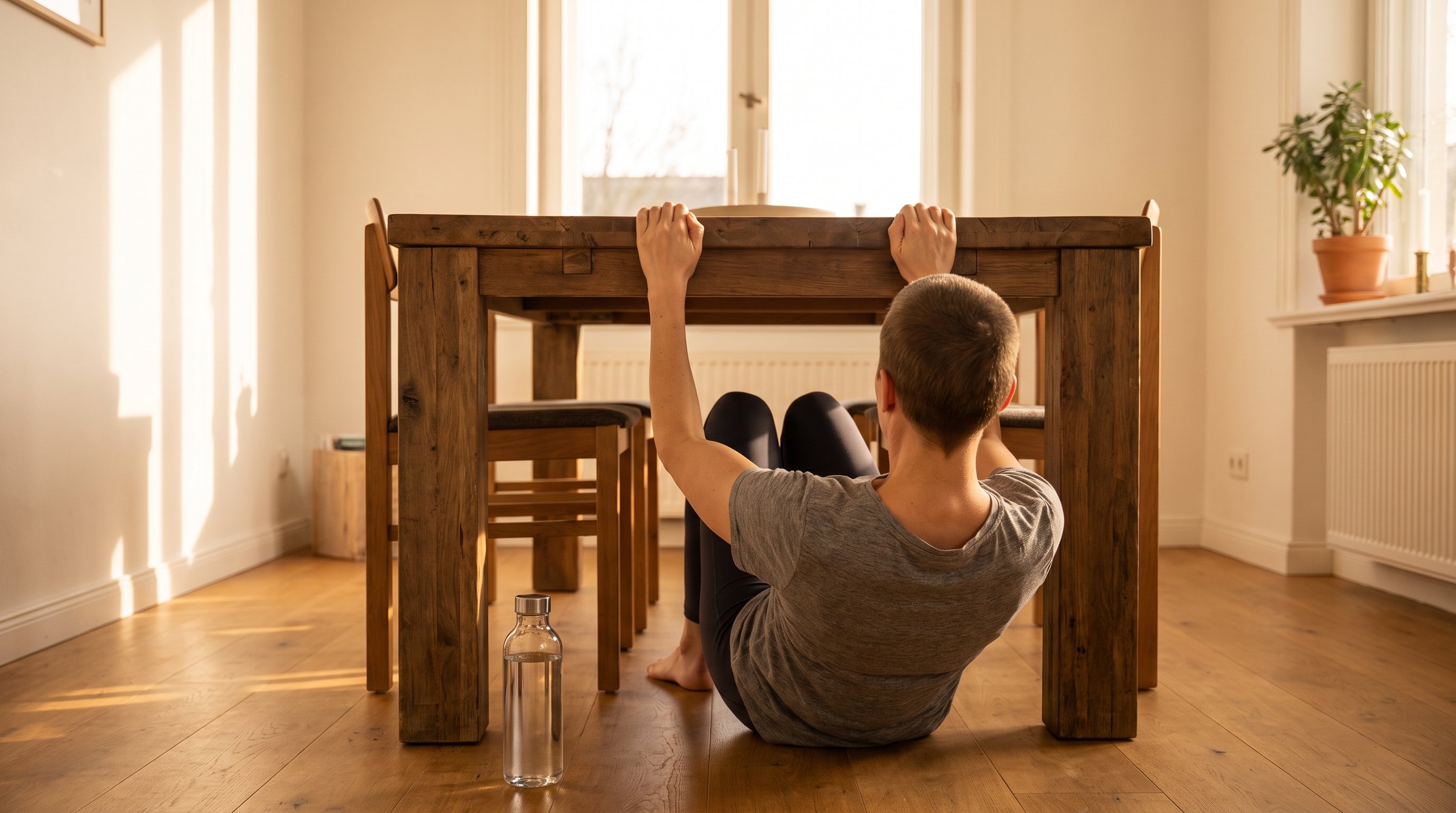
The muscle doesn't know the difference between a cable machine and a towel looped around a door handle, as long as the tension is real and the form is controlled.
What it knows is whether you showed up, and showing up is easier when the workout is already in the next room.
Making a No-Equipment Back Routine Fit Your Day
Most people don't skip training because the exercises are hard - they skip it because fitting it in feels like one more decision in a day already full of them.
Doing the routine at home removes most of that friction, since there's no travel time and no need to plan around opening hours.
Pairing a short back session with something you already track - water, steps, weight - can help it stick, which is part of what keeping progress markers in one place inside Ketoway is built for.
A ten-minute session before a shower or after brushing your teeth turns into a habit faster than one you have to schedule around someone else's timetable.
Adapting Bodyweight Back Training to Your Situation
If You're New to Training Your Back
Start with supermans and bird dogs, both of which teach you to feel the muscles along your spine working without any risk of bad form under load.
If Your Week Is Already Packed
Pick two moves instead of five and do them for eight minutes - a short session done consistently beats a long one that gets skipped.
If You're Older or Returning After a Break
Slow the tempo down and skip anything that feels like a strain on the lower back, since control matters more here than how many reps you manage.
If You Already Do Other Home Workouts
Add two back-focused sessions on the days between leg or push training, so the muscles that support posture get attention too, not just the ones you can see in a mirror.
When Back Training Motivation Usually Fades
The first couple of weeks tend to feel fine because the novelty carries you - it's usually around week three or four that sessions start getting skipped.
That's often because the moves feel the same every time and there's no obvious marker of change yet.
Staying vague about exactly when things shift is honest, since it depends on how consistent you are, but tracking sessions somewhere visible - even a simple tally - tends to keep people going past that point.
Pairing a Home Back Workout With Ketoway
A back workout does its job better when the rest of the week supports it - enough protein, enough water, and a reasonable deficit if weight loss is also the goal.
Ketoway brings a customized keto meal plan, light exercise sessions, and trackers for steps, water, weight and fasting into one place, so the training side and the eating side aren't two separate projects.
The nutrition and health guides inside the app also cover workout basics, which can help if towel rows and supermans are new territory.

Keto The Easy Way
Burn Fat With Keto
Getting Your First Session Done Tonight
The simplest way to start is to pick three moves from the sample week above and do them tonight, before deciding anything else about the routine.
Momentum from one finished session carries more weight than a perfect plan that never gets started, and pairing it with Ketoway's tracking tools can help keep that momentum visible as the weeks go on.
FAQ
Yes, bodyweight pulling and extension moves can build strength and size over time, the same way any resistance training does. How visible that change is depends on consistency and the rest of your training and eating habits.
Rows and extensions done slowly with full control can be harder than they look, especially for muscles that rarely get direct attention. Slowing the tempo or pausing at the top of each rep adds difficulty without any equipment at all.
Supermans, bird dogs, and prone raises need nothing but floor space, so they work as a complete session on their own. Rows can be added later once you find a stable edge or a doorframe that holds your weight safely.
Sessions tend to drop off when there's no clear way to see progress or when the routine never gets paired with anything else in the day. Logging sessions alongside other habits in something like Ketoway can keep the routine visible instead of forgotten.
Share this post